Titles, credits, ISRCs, ISWCs: you've already sent them to SOCAN, Sacem, Panorama or SCPP. The data exists, but on the web, it stays invisible.
Search engines and voice assistants have no reliable source about you. They show incomplete or incorrect information — or mix you up with someone who shares your name.
We wake it up.
We publish your data on Wikidata and MusicBrainz, two major open databases that search engines, voice assistants and recommendation systems rely on.
Every artist, work, recording and album gets its own unique identifier, linked to the others. No more confusion between two musicians with the same name, between a song and its fifteen versions, between an album and its reissue.
In practice, we:
Create and link your artist, work, recording and album entries
Check, correct and enrich existing entries
Handle entire catalogues, not just one track at a time
1,250+
songs and recordings
230+
artists
100+
albums
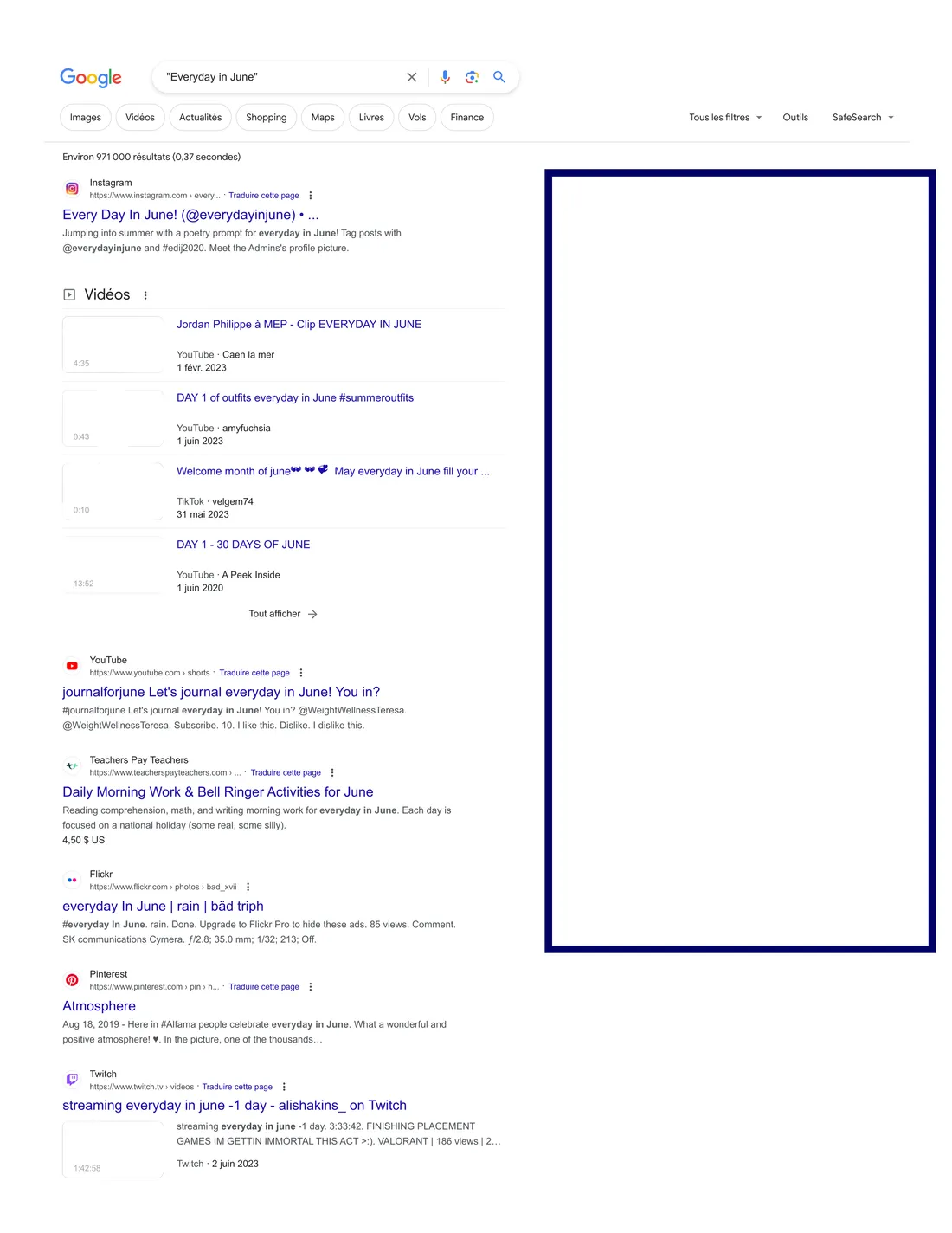
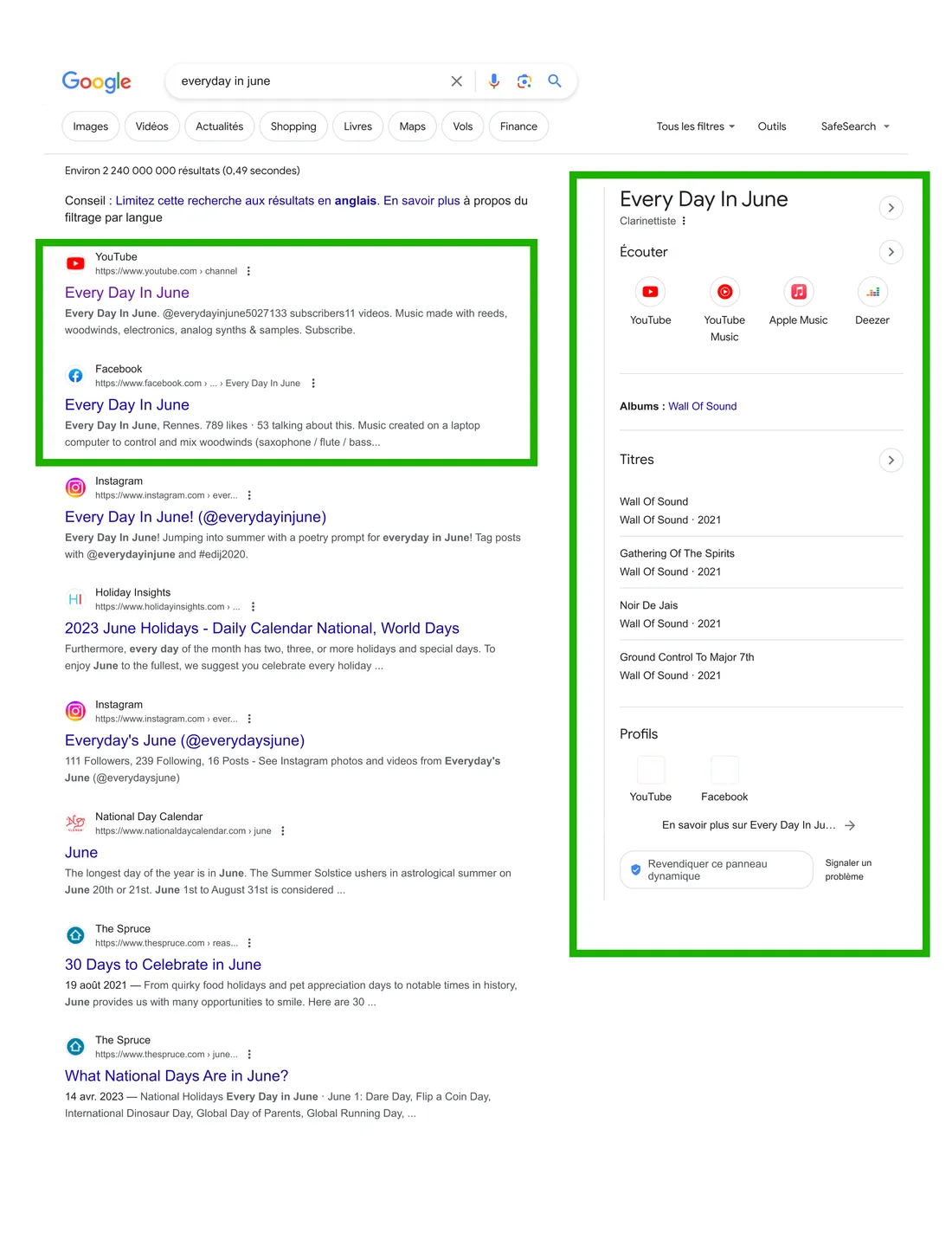
Every Day in June, before and after
Before enrichment
No knowledge panel in search results.
After enrichment
A knowledge panel shows albums, streaming links and profiles, all connected.
Real screenshots, taken before and after the metadata was published. Carried out as part of the Franco-Quebec Mission on the Digital Discoverability of French-Language Cultural Content (LATICCE–UQAM, LabEx-ICCA, FÉLIN).
Whether a panel appears is up to Google alone, with no timeline or guarantee. We control the quality of what search engines can read, not what they choose to display.
They trust us
Metadata training
Digital discoverability
Research (France)
Partner
Franco-Quebec MissionDiscoverability
Cataloguing work since 2013. Music metadata trainer at ADISQ.
Free assessment
Where does your catalogue stand?
Give us the name of your album, project or catalogue. We check its presence on Wikidata and MusicBrainz, and what search engines already show. You get a report with a discoverability score and concrete next steps.
Reviewed by a human · Report within 48 hours · No commitment
Who it's for
ArtistsLabelsPublishers
1 album or 50.
Three channels, the same spreadsheets
Your collective management organizations (SOCAN, Sacem, SCPP…)
Identify rights holders and pay them. Every contributor — composer, arranger, sound engineer — gets their share.
Your distributor
Delivers your music and its commercial metadata to streaming platforms: Spotify, Apple Music, YouTube.
Scooter Cargo
Delivers your catalogue's identity and relationships to the open web: Wikidata and MusicBrainz.
All three start from the same data and don't replace one another: they work together.
Our approach
Open data Wikidata and MusicBrainz are public. Every entry created on your behalf can be viewed at any time and depends on no private platform.
Human curation Software does the heavy lifting; a human handles what takes judgment: namesakes, duplicates, incomplete credits.
Technical rigour Built on DDEX standards and semantic web standards.
Three steps, nothing technical on your end
1. You send us your spreadsheets
The same ones you send your collective management organizations. No spreadsheet? We'll work from your album liner notes, contracts or session notes.
2. We structure and publish
Verification, duplicate and namesake resolution, publication on Wikidata and MusicBrainz.
3. You get your report
A link to every entry created. Public, viewable at any time.
Timeline: a few days to a few weeks, depending on volume.
Pricing
Transparent and scaled to volume. No surprise quotes.
One-off projects
Single
$150
€150
One song. Metadata and publication on Wikidata and MusicBrainz.
EP
$200
€200
Two to six tracks. Validation, missing identifiers, full publication.
Most popular
Album
$250
€250
Full album. Validation, enrichment, identifier research, publication.
Complex album
Custom quote
Multiple collaborations, credits to reconstruct, ambiguities to resolve.
Volume
Label package
5+ albums
from $200/album
€200/album
For labels with an active catalogue. Price decreases with volume.
Heritage catalogue
20+ albums
Custom quote
For historical collections. Quote based on the state of the sources.
Included in every project
Validation and cleanup of the metadata you provide
Research of missing identifiers (ISNI, ISWC, ISRC)
Creation and linking of artist, album, work and recording entries
Publication on Wikidata and MusicBrainz
Final report with links to every entry created
Why these prices
The music metadata market is polarized. On one side, $50–200 services that promise a Google knowledge panel within days: a promise no provider can keep, often with short-lived results. On the other, premium brand optimization services ($3,000 to $18,000), designed for entrepreneurs and executives rather than musicians.
Scooter Cargo fills the gap in between. Our software does the heavy lifting: publication on Wikidata is almost entirely automated, and on MusicBrainz our code speeds up entry creation, with each entry then validated by a human. The result: rigorous work, grounded in industry standards, at an accessible price.
And unlike cover art or mastering, well-made metadata doesn't stop at delivery: it keeps working for you for years.
Maintenance: keeping your entries up to date
A catalogue evolves: a new album, a new collaboration, a label change, a new identifier. The databases evolve too: new platforms to link, edits by other contributors, occasional vandalism on Wikidata. Without upkeep, entries don't disappear — they gradually drift away from what your catalogue has become.
Three plans
Light maintenance
— yearly
Annual integrity audit of your entries
Links updated to new platforms
Simple annual report
For artists who release at a steady pace.
$400/year
€400/year
Active maintenance
— quarterly
Quarterly audits
Progressive enrichment of existing works
Biannual discoverability report
For independent labels and active artists.
$1,000/year
€1,000/year
Full maintenance
— monthly
Monthly monitoring of your entries
Vandalism monitoring on Wikidata
New relationships added as they're detected
Detailed quarterly report
For labels with regular releases.
$2,400/year
€2,400/year
New releases are billed at catalogue rates, with a 15% discount for the duration of your subscription.
Work
Franco-Quebec Mission on Discoverability (2024)
Publication of music metadata on Wikidata and MusicBrainz for several albums by independent French-language artists and labels. Project supported by the French Ministry of Culture and the Quebec Ministry of Culture and Communications, led by LATICCE (CEIM, UQAM) and LabEx-ICCA, in partnership with FÉLIN.
ADISQ training
Co-led music metadata training sessions with Jacynthe Plamondon-Émond for Quebec music industry professionals.
Catalogues processed
Over 1,250 songs and recordings, 230 artists and 100 albums since 2022, for independent artists and labels.
About
Sylvain Picard
Composer, mixer, and — somewhere along the way — the metadata guy.
To promote my music projects, I built my first websites in 2006. By 2009, artists were knocking on my door for help with theirs and with their newsletters. First cataloguing project in 2013: everything was done by hand. In 2022, the Wikidata contracts began. The following year, the volume of data exploded — so I automated the whole thing. In 2025, I built Scooter Cargo to process several albums at once without letting a single duplicate slip through.
One foot in the studio, the other in the music industry's invisible plumbing.
No one can promise that: Google alone decides what it displays, with no timeline or guarantee. What we do is make your information accurate, complete and well connected where search engines look for it. That's the part we control; the display isn't.
Not directly. We build a chain: your metadata becomes a structured identity, linked across databases, public and reusable. Those steps are concrete and verifiable. The last one — what search engines, platforms and assistants do with it — belongs to them. We give them what they need to understand you, not orders on what to display.
No. Your collective management organizations pay rights holders, your distributor delivers your music to streaming platforms, and Scooter Cargo publishes your catalogue's identity on the open web. Same spreadsheets to start, three different destinations.
Wikidata and MusicBrainz. Their identifiers then circulate widely: Wikipedia, aggregators, music databases and industry tools all refer to them.
No. Each database has its own data model, rules and community; what works in one doesn't carry over mechanically to the other. That's why part of the work stays human: telling namesakes apart, distinguishing a work from its recordings, establishing relationships.
Your metadata spreadsheets — the ones you send to your collective management organizations. If you don't have any, we can work from your album liner notes, contracts or session notes.
Automated processing takes a few minutes. The full project, including human validation and publication on MusicBrainz, takes a few days to a few weeks depending on volume.
Yes. They're public, and can be viewed and edited at any time.
We check, correct, enrich and link them together. That's often where the biggest discoverability gains are.
Without upkeep, entries gradually drift away from the reality of your catalogue. See our maintenance plans in the Pricing section.
$150 / €150 for a single, $200 / €200 for an EP, $250 / €250 for an album. Details in the Pricing section.